Have you ever had a conversation about periods during a work meeting? Or asked your boss about the quality of period care in your office — if it's there at all?
Most period-centred conversations at work happen in hushed tones over lunch or in the bathroom. A significant portion of the population menstruates each month, and yet we've been trained into silence on one of the most important biological processes — told to "deal with it" and that it's inappropriate to discuss.
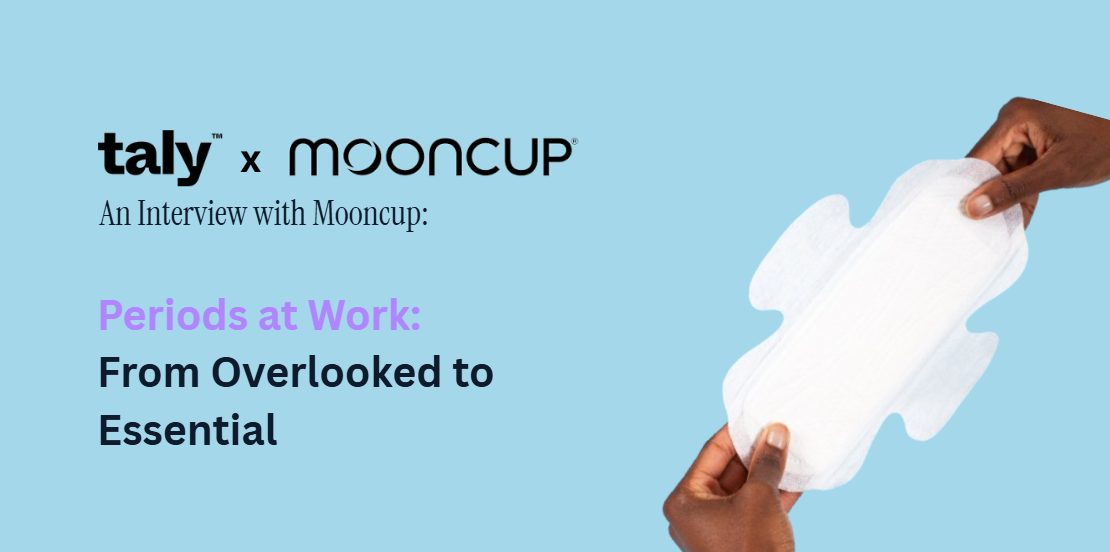
Mooncup is a period product company working to change how periods are viewed in the workplace, from overlooked to essential.
We sat down with Mooncup's Lydia Borwell to talk about the steps they're taking, and what every workplace can do to build a better, brighter future for everyone who menstruates.
Periods carry a lot of stigma in and outside the workplace. What does it take for a company to be genuinely period-positive and what does that look like?
Being period-positive isn’t always about bold policies (although we love hearing about those too).
It’s about recognising that periods are a normal part of life for a significant proportion of the workforce, and ensuring people can participate fully at work without unnecessary barriers.
The organisations doing this best tend to take a three-part approach.
- They provide period care. It is treated not as a perk, but as an essential, alongside toilet paper, soap and hand towels.
- They make their commitments clear. Whether through wellbeing strategies, policies or communications, they signal that menstrual health matters and that support is available.
- Perhaps most importantly, they bring those commitments to life. Policies often have a habit of sitting on paper without translating into real experiences. Steps should be taken to equip managers, educate employees and create a culture where people actually feel comfortable accessing support.
You offer educational resources and menstrual health content to businesses. What are the biggest misconceptions or gaps in knowledge you’re finding, even among well-meaning employers?
There has long been this underlying assumption that providing period products is going above and beyond - that it is treating the women in your workplace to an extra perk.
Remember the tampon tax (the one that applies to luxury items) was only abolished in the UK in 2021, so it is no surprise that perception has a long way to go.
It is encouraging to see more employers, education providers, gyms and shared spaces bringing period care in as standard. But the next step is changing how we think about it.
Free coffee and work socials are perks. Period care is not. Even the most well-meaning employer can fall short if they see period care as a favour rather than infrastructure.
Research suggests the majority of women still feel anxious managing their period at work. What small changes tend to have the biggest impact on making people feel supported?
Around 85% of women report feeling stress or anxiety managing their periods at work, so this is far from a niche issue.
Impactful changes are often simpler to make than you’d think. If you can remove those small moments of stress, uncertainty or discomfort from someone's day, you are already making a tangible difference.
Providing free period products is a good example. It won't solve every challenge, but it does something important: it signals that this is a space where people's needs have been considered. The message is: we've thought about this, and we've got your back.
The quality of those products matters too. Increasingly, organisations are thinking not just about whether they provide period care, but what they're providing. Keeping health, comfort and wellbeing in mind creates confidence that the support being offered is of a high standard.
Menstrual health is increasingly showing up in the employee experience and productivity conversation, not just as a duty-of-care checkbox. How do you see that shift unfolding, and does that framing feel like progress to you?
I would love period care in the workplace to be there simply because it is the right thing to do... But businesses do sometimes need another nudge to make it happen.
Fortunately, the evidence is becoming hard to ignore; How businesses approach this has a real impact on how people experience work.
On productivity - There is the time spent leaving the office to find a shop, buying products, and then getting back to the bathroom. There is the time spent worrying, or trying to perform through discomfort. That all has an impact.
And then there is retention - We know that 8% of women have left or are considering leaving workplaces where they do not feel supported with menstrual wellbeing. I’ve met women who have walked away from roles because their symptoms were not understood or accommodated.
Those people do not disappear. They go on to thrive in more supportive environments.
So yes, I do think this framing menstruation with employee experience and productivity is a positive shift. Just as long as we do not lose the human point.
Supporting people is the right thing to do. It also helps businesses keep talented people and get the best from them.
How can better period care support inclusivity and sustainability at the same time?
The two go hand in hand because they're both reflections of values.
Many organisations prioritise ESG, wellbeing and inclusion. We scrutinise the food in canteens, the suppliers we choose and the environmental impact of our purchasing decisions. Bathrooms can be a blind spot in workplaces.
That's becoming increasingly out of step with consumer expectations. In retail, we're seeing people gravitating towards products that reflect their values and prioritise their health. It's natural that those expectations start to extend into the spaces where people spend their time - including work.
Period care sits at the intersection of health, inclusion and sustainability. Choosing Mooncup over a mainstream period care brand is a choice organisations make for a reason.
So many people have no idea what’s really in their period products. Can you walk us through what conventional period care is typically made of, why that's a concern, and how Mooncup approaches materials differently? And with Plastic-Free July coming up, why is this particular moment such a good opportunity to start that conversation?The average person will use around 11,000 period products in their lifetime, so it's important to us that we know exactly what they contain.
Many period care products contain synthetic materials, fragrances, dyes and petroleum-based plastics. Some tampons also use plastic veils designed to reduce fibre shedding, which have been shown to break down into billions of nanoplastic particles while in use.
Mainstream pads can contain up to 95% plastic, so a pack of Mooncup pads saves the equivalent of around five plastic bags from landfill.
And this isn't just a sustainability conversation. Poorly chosen materials can contribute to discomfort for people already managing periods, sensitive skin or gynaecological conditions. That discomfort follows people into meetings, workouts, lectures and everyday life, affecting comfort, confidence and concentration.
Yet ingredient transparency is still far from standard across the industry.
At Mooncup, we're transparent about every material in every product. Our pads use a 100% organic cotton topsheet, an FSC-certified cellulose absorbent core and a plant-based leakproof backsheet made from cornstarch. Our tampons are made from 100% organic cotton, with cardboard applicators and paper wrapping. No synthetic fragrances, no dyes and no petroleum plastics.
We don't think people should have to choose between performance, health and sustainability.
Plastic Free July is a great moment to have this conversation because it encourages people to look more closely at the products they use every day. It's also a useful opportunity for organisations. If a business says it cares about sustainability and employee wellbeing, period care is one of the most practical places where those commitments overlap.
Making period products more accessible is a core focus for Mooncup. How do you think greater accessibility could shift the way periods are perceived more broadly?
Access has always been central to Mooncup's mission. We started by creating the original silicone menstrual cup, which is incredible from an accessibility perspective because you buy it once and can use it for years.
Over 20 years later, with a full range of period care products, our pads and tampons are showing up in shared bathrooms all over the place - with the same goal of making periods less of a barrier for people.
Greater accessibility of products in public spaces challenges the idea that periods should be hidden away or shameful. When they’re available in the same way as other essentials, periods start to be recognised for what they are: a normal part of life.
That shift matters because not acknowledging periods has consequences beyond the bathroom. Historically, I believe it has contributed to a lack of investment, research and understanding across many areas of women's health.
We're beginning to see that change. Mooncup partners with researchers exploring the potential of menstrual blood in medical research and diagnostics - work that reflects a growing willingness to look at periods not as something to be ignored, but as a vital piece of the picture of women's health.
Accessibility means visibility, and hopefully, better outcomes for women.
What’s the end goal for Mooncup? What does a world with a truly healthy relationship with periods look like?
I’d like to see a world where periods aren't a barrier to participation, comfort or opportunity. That means access to safe, sustainable period care wherever you need it.
The end goal is simple: nobody should have to plan their day, miss out on opportunities or feel uncomfortable because they got their period and couldn't access the products they needed.
It’s obvious that we’re far from period perfect but menstrual health is becoming a larger conversation that is so important to take part in.
In a world of closing deadlines and office politics, we have the power to shift periods from yet another thing to deal with into something nobody has to stress over at work. And it all starts with providing access. So start the conversation at your office today and change periods for the better, by adding a box of Mooncup products to your next order!
If you want to learn more about Mooncup and their products visit wearemooncup.com
Have questions about getting Mooncup into your office? Email info@wearetaly.com to book a meeting.